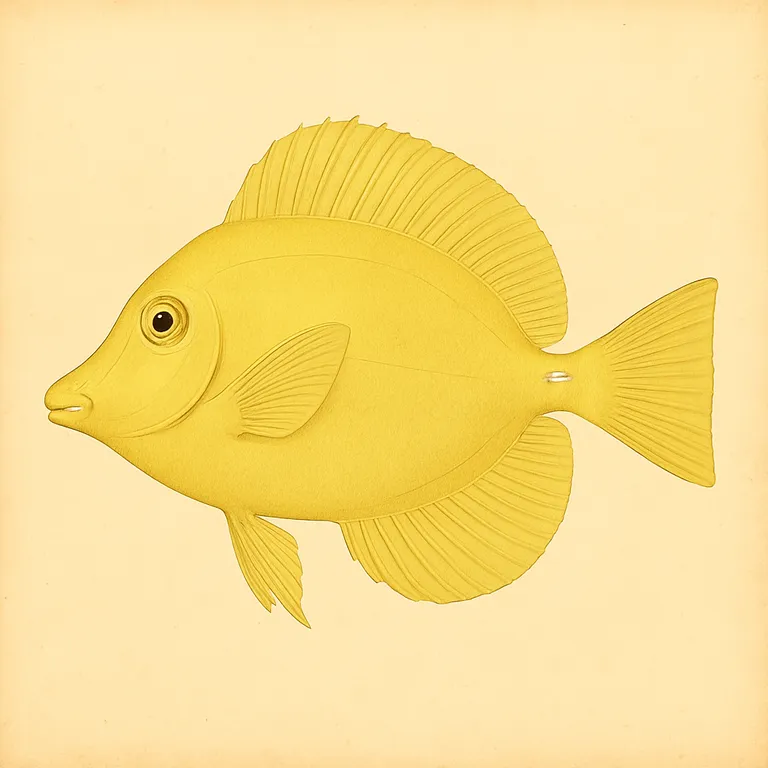
Yellow tang
Zebrasoma flavescens
FishSaltwater
- Care level
- Moderate
- Temperament
- Semi-aggressive
- Reef safe
- Yes
- Recommended tank
- 350 L
- Maximum size
- 20 cm
- Temperature
- 24–27 °C
- pH
- 8–8.4
- Diet
- Herbivore
Care at a glance
The yellow tang is the calling card of many a reef aquarium: a bright-yellow, ever-swimming presence that brings a whole tank to life on its own. It is a herbivore that grazes all day, helpfully keeping the algae down as it goes.
That urge to swim means it genuinely needs space; in a small tank it becomes restless and irritable. Towards other tangs, especially its own kind and species with the same silhouette, it can be fierce. Offer vegetable food daily, such as nori on a clip, alongside the regular menu.
Origin and habitat
Zebrasoma flavescens comes from the Pacific and is best known from the reefs around Hawaii. There it roams shallow reefs in loose groups, grazing fine algae off the rock all day. It wants to do the same in the aquarium: live rock with a film of algae growth keeps it busy between feeds.
Setting up the tank
Give it a long, open swimming area and strong flow throughout the tank. Rockwork arranged as a few separate islands, or kept compact against the back glass, leaves enough room to swim laps. It helps keep hair algae short, but it will not cure an algae outbreak and leaves cyanobacteria alone.
Behaviour and tankmates
Ideally, add it as one of the last fish. A tang that already regards the tank as its territory reacts more aggressively to newcomers. More than one yellow tang only works in a very large aquarium, with fish that are introduced at the same time.
In the dark it fades and a white band appears along its flank. That is its night colouration, which disappears again shortly after the lights come on. When catching it, watch out for the white spine at the base of the tail, and use a container rather than a net.
Feeding
Alongside nori on a clip, dry food rich in seaweed or spirulina belongs on the menu, spread over a few small portions a day. It also eats frozen food such as mysis, but plant food remains the basis. If its yellow fades during the day or the belly sinks in, it is often getting too little food or a diet that lacks variety.
Health and breeding
Like other tangs, it is susceptible to white spot, so keep a new fish in quarantine for several weeks first. Pale, pitted patches around the head and along the lateral line, known as HLLE, are often linked to an unvaried diet and mediocre water quality.
There is no reliable external difference between males and females. Breeding in a home aquarium does not work in practice, because the larvae spend weeks drifting as plankton in open water.
Good to know
Best not combined with
Related species

Keep Yellow tang in the BlubHub app
Add this species to your inhabitants, with count and photos, and see the care info next to your own water values, target bands and reminders. Free, no account, everything on your own device.
Values are mainstream hobbyist guidance, not gospel. Always watch what your own animals need.