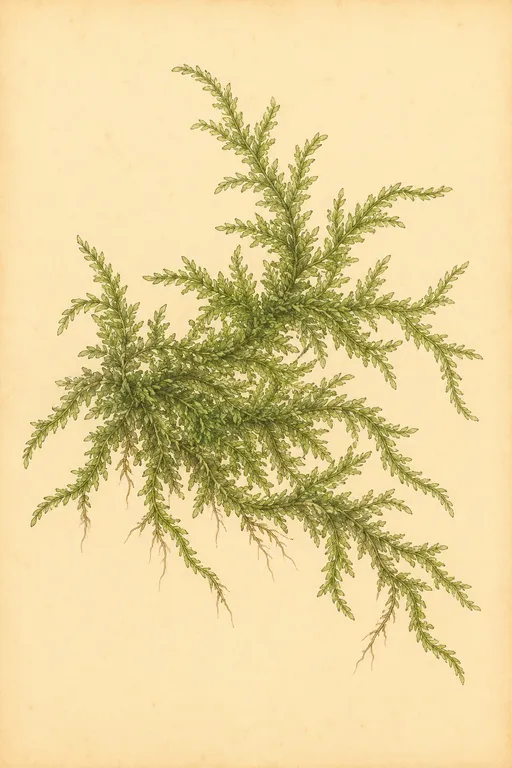
Java moss
Taxiphyllum barbieri
PlantsFreshwater
- Care level
- Easy
- Maximum size
- 10 cm
- Temperature
- 18–28 °C
- pH
- 5.5–8
- Light
- Low
- Diet
- Photosynthetic
Care at a glance
Java moss is the workhorse of aquarium mosses: a tangled, light-green tuft that attaches to anything, keeps growing at almost any temperature and light level, and needs no substrate or CO2. You tie it on with fishing line or glue it to wood or stone, and after a few months the attachment is invisible.
Its greatest value is below the surface: the dense structure teems with micro-life and is the best nursery you can give shrimp and newly hatched fry. Trim it regularly, because a thick, dense cushion clogs up inside and starts rotting brown in there. Detritus that collects in it simply rinses out during a water change.
Name and related mosses
What is sold as Java moss is, by current classification, usually Taxiphyllum barbieri. For a long time it was called Vesicularia dubyana, and you will still often come across that name in shops and older books.
Christmas moss and weeping moss look similar at first glance but grow more regularly: Christmas moss in flat, triangular sprigs reminiscent of fir branches, weeping moss with drooping tips. Java moss grows messier and faster and is less fussy.
Uses in the tank
Because Java moss attaches to anything, you can shape it. Sandwiched between two layers of stainless steel mesh it becomes a green mat on the bottom or a moss wall against the back glass, and on a branching piece of wood it grows into a little tree.
In a breeding tank Java moss is a well-known spawning site for fish that scatter their eggs among plants, such as many barbs, danios and rainbowfish. The eggs sink into the moss, where the parents have a harder time reaching them.
Light and growth
In low light Java moss grows slowly and loosely and turns a darker green. With more light and CO2 it becomes denser and grows faster, but algae get more of a chance too.
Hair algae are the biggest problem: they weave through the moss and are almost impossible to get out. Cut the affected part away generously and lower the light a little; starting again with a clean clump is better than trying to rescue a contaminated one over and over. Amano shrimp eat hair algae and help keep a patch of moss clean.
Propagation and trimming
Every loose bit of Java moss grows into a new clump, so propagating is no more than cutting off a piece and attaching it somewhere else. The same goes for the clippings that come loose when you trim: they drift off, take hold among other plants or end up in the filter intake.
So switch off the filter while you trim and scoop the clippings out with a fish net.
Related species


Keep Java moss in the BlubHub app
Add this species to your inhabitants, with count and photos, and see the care info next to your own water values, target bands and reminders. Free, no account, everything on your own device.
Values are mainstream hobbyist guidance, not gospel. Always watch what your own animals need.