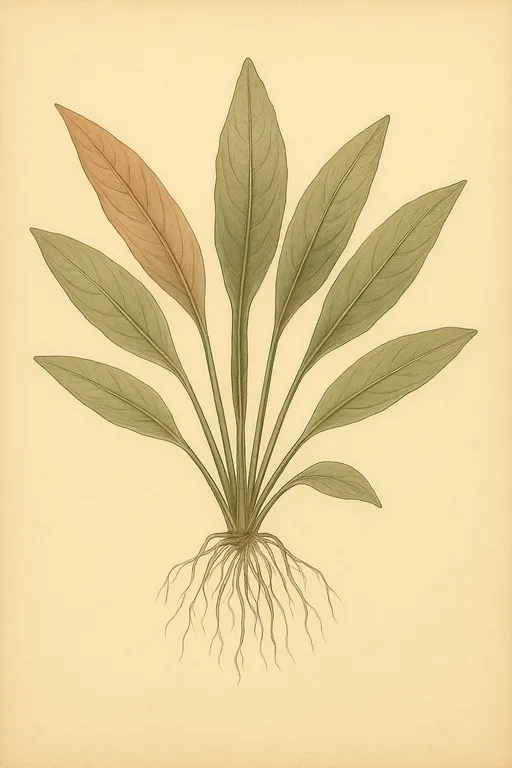
Amazon sword
Echinodorus grisebachii
PlantsFreshwater
- Care level
- Easy
- Maximum size
- 50 cm
- Temperature
- 22–28 °C
- pH
- 6–7.5
- Light
- Medium
- Diet
- Photosynthetic
Care at a glance
The Amazon sword is the classic specimen plant for the back wall: a rosette of broad, light-green leaves that easily reaches half a metre and forms the centrepiece of a tank all by itself. It asks for no CO2, but it does need space and patience.
Unlike most aquarium plants it feeds mainly through its roots, and those grow substantial. So plant it in a nutrient substrate or push a few root tabs underneath it; liquid fertiliser alone is not enough and produces exactly the holes and yellow leaves people complain about. On purchase the leaves are often still in emersed form. Those die back, and that is normal.
Origin and naming
The Amazon sword comes from Central and South America, where it grows as a marsh plant in shallow water and on banks that dry out for part of the year. That is why nurseries grow it largely above water.
In the trade you will find it as Echinodorus bleheri, amazonicus or grisebachii. Botanists now group those forms under the last name; for its care it makes no difference which label is on the pot.
Planting and placement
When buying, choose a plant with firm leaves and white, intact roots, without brown or soft spots in the crown. Trim long roots back to a few centimetres and plant it deep enough that the roots sit well in the substrate while the crown, where the leaves emerge, stays just above it. A crown that disappears into the substrate will rot.
Give it a permanent spot and a substrate with some depth, and preferably do not move it afterwards: pulling it up damages the root system and growth stalls for a while. In a small tank it soon takes the light away from everything beneath it.
Light and nutrients
Under medium light the rosette stays relatively compact. In a dim tank the leaf stalks stretch and the plant grows taller and floppier. Under bright light without enough nutrients, algae appear on the oldest leaves.
Young leaves that come out pale with green veins usually point to a lack of iron. Root tabs under the plant run out over time; as a rule you add new ones every few months. Old outer leaves that are decaying can be cut off at the base.
Propagation
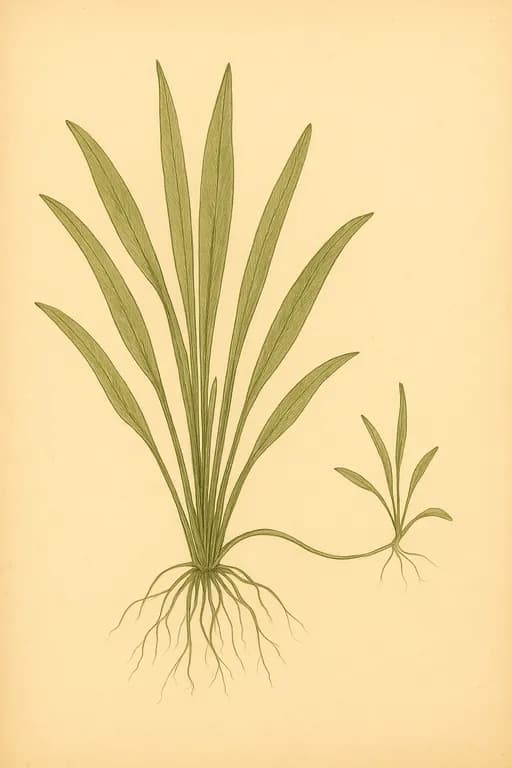
A mature Amazon sword eventually produces long stems, sometimes with small flowers, on which young plantlets form. Leave them on the stem until they have a few leaves and roots of their own. Then you can weigh the stem down to the substrate with a small stone so the plantlet roots there, or cut it off and plant it separately.
Related species

Keep Amazon sword in the BlubHub app
Add this species to your inhabitants, with count and photos, and see the care info next to your own water values, target bands and reminders. Free, no account, everything on your own device.
Values are mainstream hobbyist guidance, not gospel. Always watch what your own animals need.