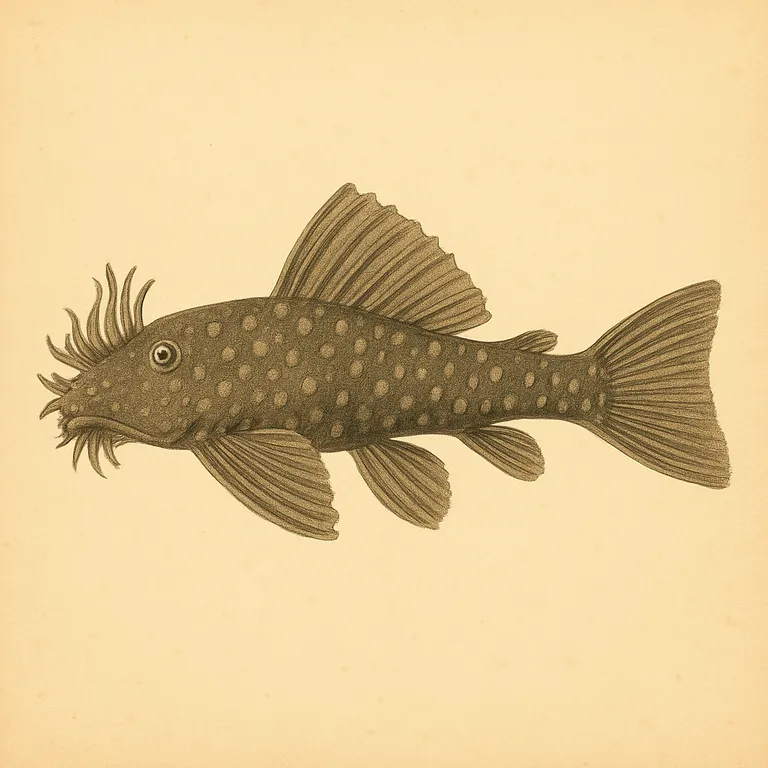
Bristlenose pleco
Ancistrus sp.
FishFreshwater
- Care level
- Easy
- Temperament
- Peaceful
- Recommended tank
- 80 L
- Maximum size
- 13 cm
- Temperature
- 22–27 °C
- pH
- 6–7.8
- Diet
- Herbivore
Care at a glance
The ancistrus, or bristlenose, is the sensible choice for anyone wanting an algae eater: unlike the well-known common pleco it stays compact enough for an ordinary living-room tank. Males are unmistakable thanks to the bushy growths on their snout.
It is a twilight and night creature that likes to spend the day tucked under driftwood or in a cave. Make sure there is real wood in the tank: it rasps off fibres that its digestion needs. Supplement algae with vegetable tablets and greens, because a tank alone rarely produces enough food.
Origin and varieties
Ancistrus species live across large parts of South America in streams and rivers with flowing, oxygen-rich water, among rocks and fallen wood. The bristlenose pleco sold in shops is a form that has been bred in aquariums for a very long time and whose exact species is uncertain, hence the name Ancistrus sp. Besides the brown form there are albinos, yellow and red colour forms and long-finned fish, all of which need the same care.
Setting up the aquarium
A good filter with some current suits the origins of the bristlenose pleco. The fish also produces a lot of waste, so choose a filter with ample capacity and siphon the bottom regularly. Give each male a cave or hollow of his own that he just fits into. If there are more males than caves, there will be jostling for the best spot.
Feeding
Suitable vegetables include courgette or cucumber, sliced and briefly blanched, or shelled peas. A vegetable clip or a clean fork keeps a slice on the bottom. Feed when the lights go off, because that is when it is active and the other fish are slower to compete. Remove any vegetables still lying there after a day, before they start to rot. A sunken belly means it is not getting enough.
Male or female
Adult females have at most a row of short bristles along the edge of the snout, while the male also carries long, sometimes branched bristles in the middle of the head. In young fish the difference cannot be seen yet, because the male's bristles only grow as he matures.
Breeding
In an ordinary aquarium the bristlenose pleco often breeds on its own. The female lays a cluster of orange eggs in the male's cave. He guards them, fans fresh water over them and stays with the young until they leave the cave by themselves.
The young start rasping on wood and algae straight away and eat the same vegetables as their parents. A pair can produce a new clutch regularly, so think ahead about where the young can go, for example a shop or an aquarium club.
Good to know
Related species

Keep Bristlenose pleco in the BlubHub app
Add this species to your inhabitants, with count and photos, and see the care info next to your own water values, target bands and reminders. Free, no account, everything on your own device.
Values are mainstream hobbyist guidance, not gospel. Always watch what your own animals need.