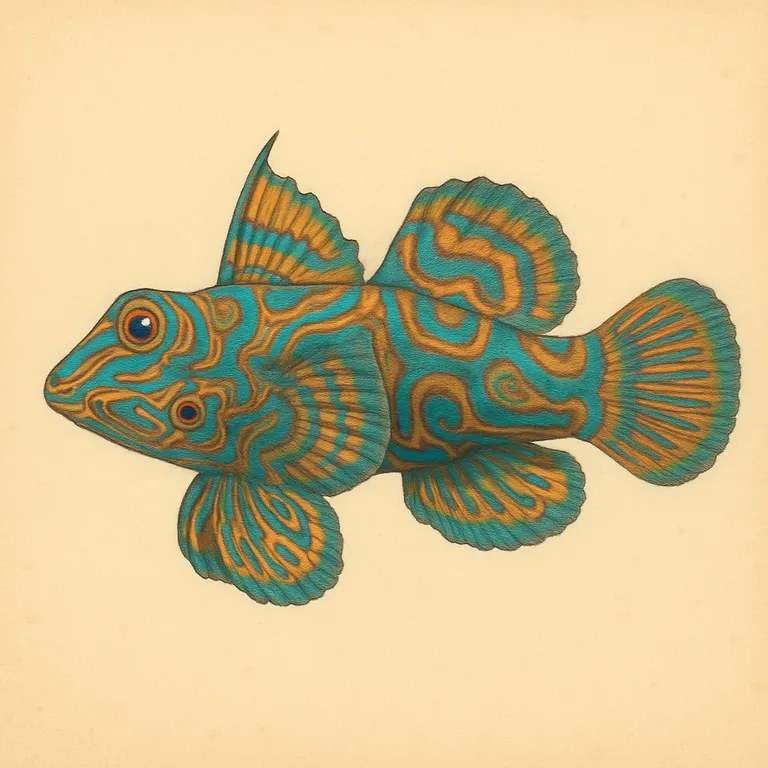
Mandarin dragonet
Synchiropus splendidus
FishSaltwater
- Care level
- Demanding
- Temperament
- Peaceful
- Reef safe
- Yes
- Recommended tank
- 250 L
- Maximum size
- 8 cm
- Temperature
- 24–27 °C
- pH
- 8–8.4
- Diet
- Carnivore
Care at a glance
The mandarin dragonet is one of the most beautiful fish in the marine hobby: a small, slow-moving animal with a pattern of orange, green and blue that looks painted on. It hovers over the reef all day on its pectoral fins, picking constantly at the rock.
That feeding behaviour is precisely the problem. It lives on copepods and grazes all day long, and a tank has to produce enough of them to keep that up. That calls for a large, long-established system with plenty of live rock and preferably a refugium. A new tank almost certainly means a slowly starving fish. Captive-bred specimens that accept frozen food are the safer choice.
Origin and way of life
Synchiropus splendidus lives in the western Pacific, in sheltered lagoons and coastal reefs among coral rubble and branching corals. It belongs to the dragonets, like the common dragonet of the North Sea, so the trade name mandarin goby is wrong: it is not a goby. It has no ordinary scales; a thick, foul-tasting layer of slime protects it from predators.
When your tank is ready
A rule of thumb in the hobby is that the tank should have been running stably for at least six months to a year before a mandarin dragonet goes in. Check the copepod population yourself: after the lights go out, shine a torch on the glass and the rocks. In a suitable tank you will see small white creatures crawling everywhere. Adding copepods from a culture also helps, provided you do it well before the fish arrives, so they can multiply first.
Feeding and captive-bred fish
Even a captive-bred fish that eats frozen food remains a slow eater. In a tank with fast fish, the food is often gone before it gets there, so treat frozen food as a supplement to copepods. Some keepers feed it with a pipette close to its head or use a small feeding dish on the bottom that only it can get into.
Ask in the shop whether you can see it eat, and look at the belly. It should be rounded; a sunken belly or a narrow back just behind the head means the fish has been eating too little for too long.
Behaviour and tankmates
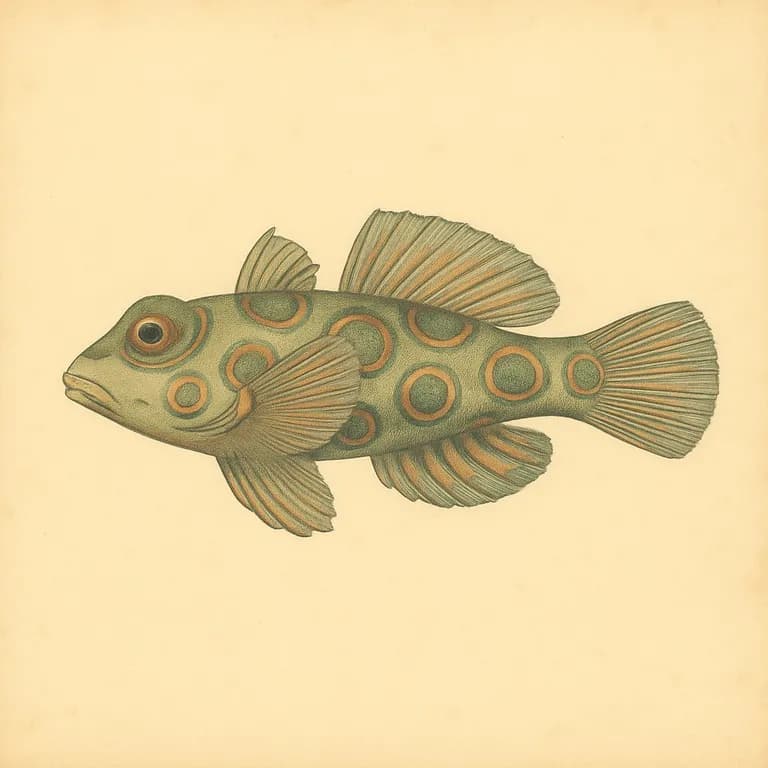
Two males will fight. A pair is possible, but together they eat twice as many copepods. Other copepod eaters, such as wrasses or the spotted mandarin, use up the supply even faster. Calm fish that feed in open water, such as a pair of clownfish, make better tankmates.
Male or female
The male is larger and has a strikingly tall, pointed first dorsal fin; in the female this fin is much smaller. A pair sometimes spawns at dusk, with both fish rising a short way up into the water together. The eggs drift off and in a normal aquarium are eaten or removed by the filtration.
Good to know
Related species

Keep Mandarin dragonet in the BlubHub app
Add this species to your inhabitants, with count and photos, and see the care info next to your own water values, target bands and reminders. Free, no account, everything on your own device.
Values are mainstream hobbyist guidance, not gospel. Always watch what your own animals need.